Most thought leaders believe their problem is time. They believe if they just had more of it, the articles would get written. The book would get finished. The frameworks would finally make it out of their head and onto a page where someone could find them, learn from them, and build on them.
Time is not the problem.
If anything you just tapped landed, the rest of this article is for you. The bet we took, the wins that landed before any external metric had time to move, and the numbers we are committing to publish at six months and twelve months so you can decide for yourself.
The numbers above are not bad luck. They are the predictable result of trying to publish without architecture. Talent and willpower help. Timing and luck matter. But of all the variables an expert can actually control, infrastructure is the one most consistently missing on the abandoned side.
This is the article we should have written first. It is the architecture behind everything else in this library, and it is the architecture most thought leaders never build because nobody told them it had to exist before the writing could.
Before we talk about how to build, we should talk about what is at stake for the experts who do not.
The Edelman-LinkedIn 2025 B2B Thought Leadership Impact Report contains one of the most consequential findings in the discipline. The chasm it documents is the entire reason this article exists.
The gap between those two numbers is the entire game. Most experts are publishing nothing, which means their wisdom does not exist in the market. The few who are publishing are usually publishing the same templated content their competitors are publishing, which means they live inside the seventy-one percent that decision-makers ignore. Experts publishing original, research-backed, well-architected content occupy a much smaller field.
And the data on what that narrow band actually receives is striking.
And the world has shifted underneath all of this in a way that makes the asymmetry even sharper. Forty percent of B2B buyers now begin vendor research with AI tools, on par with the forty-one percent who still use traditional search. ChatGPT reached nine hundred million weekly active users in early 2026 and is used by ninety-two percent of Fortune 500 companies. Brands cited in AI Overviews earn thirty-five percent more organic clicks than uncited competitors.
Which means the rules of who gets found just changed.
AI cannot cite expertise that does not exist on the public internet. A decade of hard-won insight, locked inside your head and inside private client conversations, is invisible to the systems your buyers are now using to search.
This is not a vanity argument for publishing. It is an existential argument for it.
The research above is the case for publishing. It is not the same as proof that publishing has worked for us. We have been at this for three weeks.
What I can tell you, with full certainty, is why we did this. And what has already shifted in our work because of it.
3 internal wins arrived before any external metric had time to move.
Traffic, leads, citations, revenue would be welcome additions to what is already working — but they are not what we are betting on for the wins to count.
The honest part about how this got built.
I would not have attempted this without AI. As tempting as the idea has been for years, the reality of citations, original research, stat verification, editorial-quality publishing, indexing for both Google and AI search, English-Spanish parity, schema markup, and ongoing optimization was never going to fit between the rest of an over-committed founder's priorities.
The expertise still has to be ours. The judgment, the framework selection, the editorial taste, the willingness to say something that might be wrong but is at least honest — none of that can be outsourced. But the friction that kept this work locked in my head for a decade is gone.
The Searchability Game Plan — how a library stays sharp
The library is alive. Every article we publish gets formatting improvements, citation refinement, and alignment with the rest of our content. Behind that maintenance is a structured 90-day searchability program a team member is learning to work through, drawing on SEMrush, Moz, and Jason Barnard's research on entity-based authority.
It is the same pattern we've found valuable for the experts and operators we serve. To make the principle concrete, here is one example of what this kind of plan looks like in practice.
This is what we mean by infrastructure that earns inbound on its own. The system is the multiplier. The expertise is yours.
Why we believe in foundation-then-distribution
This is not our first time building a deep library and waiting on the world to find it.
The blog may be on the same arc. We are seeing early signals — feedback from specific readers on specific articles — but three weeks is far too early to claim the principles we are following are working. We are not going to activate distribution until each article is one we would defend. If the principles are right, the work compounds the way the YouTube channel finally did. If they are not, the data at six and twelve months will tell us.
The bet is not that this article is perfect today. The bet is that the foundation is being built correctly, and that the system around it is engineered to scale when the time comes.
An honest article about a bet is incomplete without the KPIs that bet is being measured against. So here it is, in the open, with the research the forecasts are anchored to.
Two horizons. Six months and twelve months. Each metric carries the source that grounds it, the range the research suggests is realistic, and a line where I get to weigh in personally. Because I am not going to be obedient to the consensus. Some of these numbers I think we will hit. Some I think we will miss. Some I think we will exceed.
My Prediction / Observation lines are intentionally separated from the research so you can see where the data ends and where I begin. The data is the floor. My read is the wager.
Some of these predictions land confident. Some I openly do not understand yet. Some carry a side-note about working with AI as a junior advisor — because that is part of the experiment, too. The variation is the integrity of it. If every prediction sounded equally confident, you should not trust any of them.
Each card shows the tight prediction. Where there is more to say — reasoning, screenshots, asides — tap "Read the full thinking" beneath the prediction to expand it.
Six months is the abandonment point most thought-leadership programs never make it past. It is also the point at which the research says foundational signals start to move.
I guess I should start by seeing where we are at, but I would think a 110% lift should be pretty easy since we don't focus on digital distribution. I would also guess that a 110% lift will be fairly negligible in terms of profitability or scale — we're pretty maxed out on opportunities as it is. We've never had great organic leads from organic traffic for First Class Business. Ever. So I won't hold my breath, but I will build with principles and trust in the process.
I went to Google Analytics. Here's what the data shows for whatever it's worth.
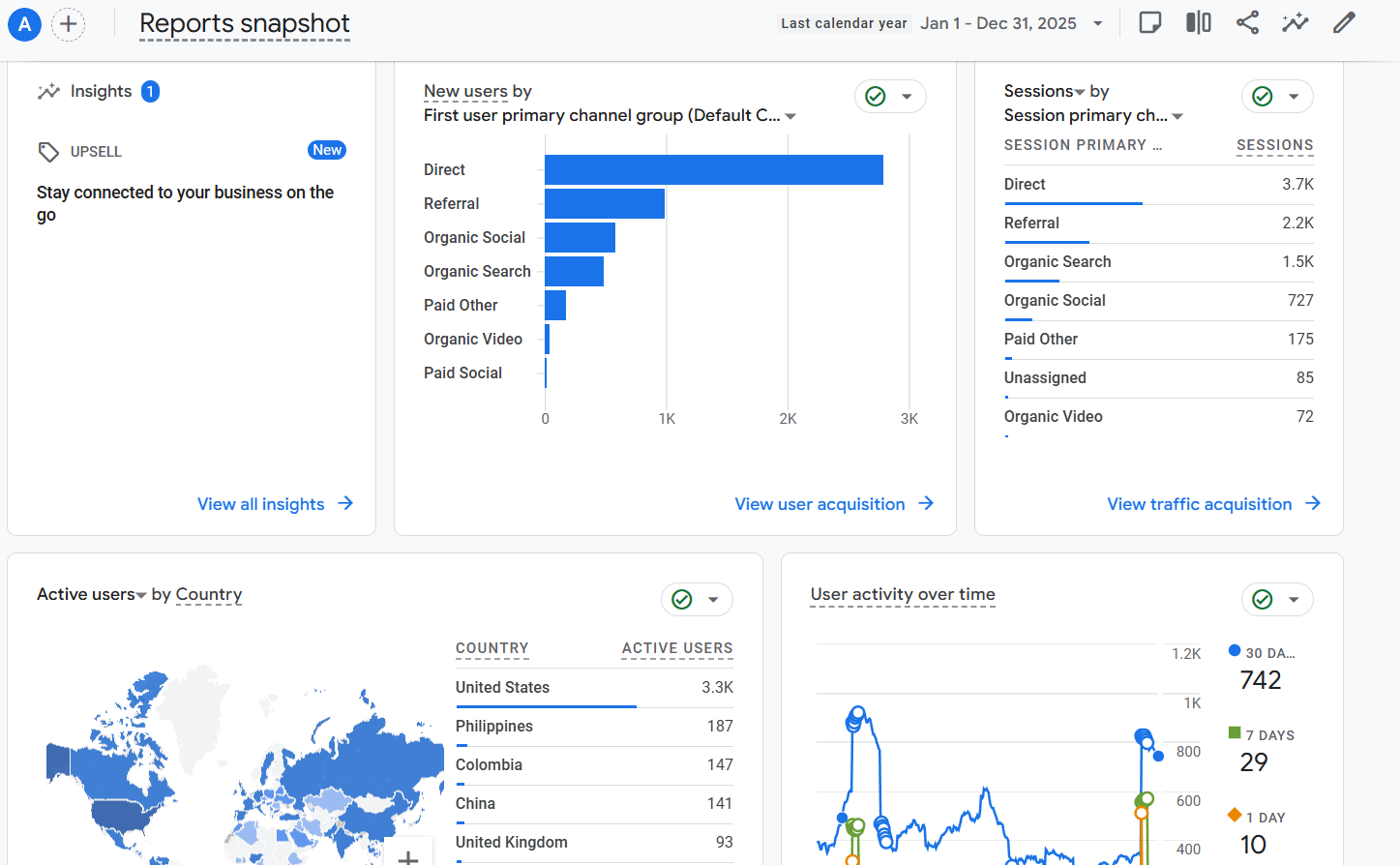
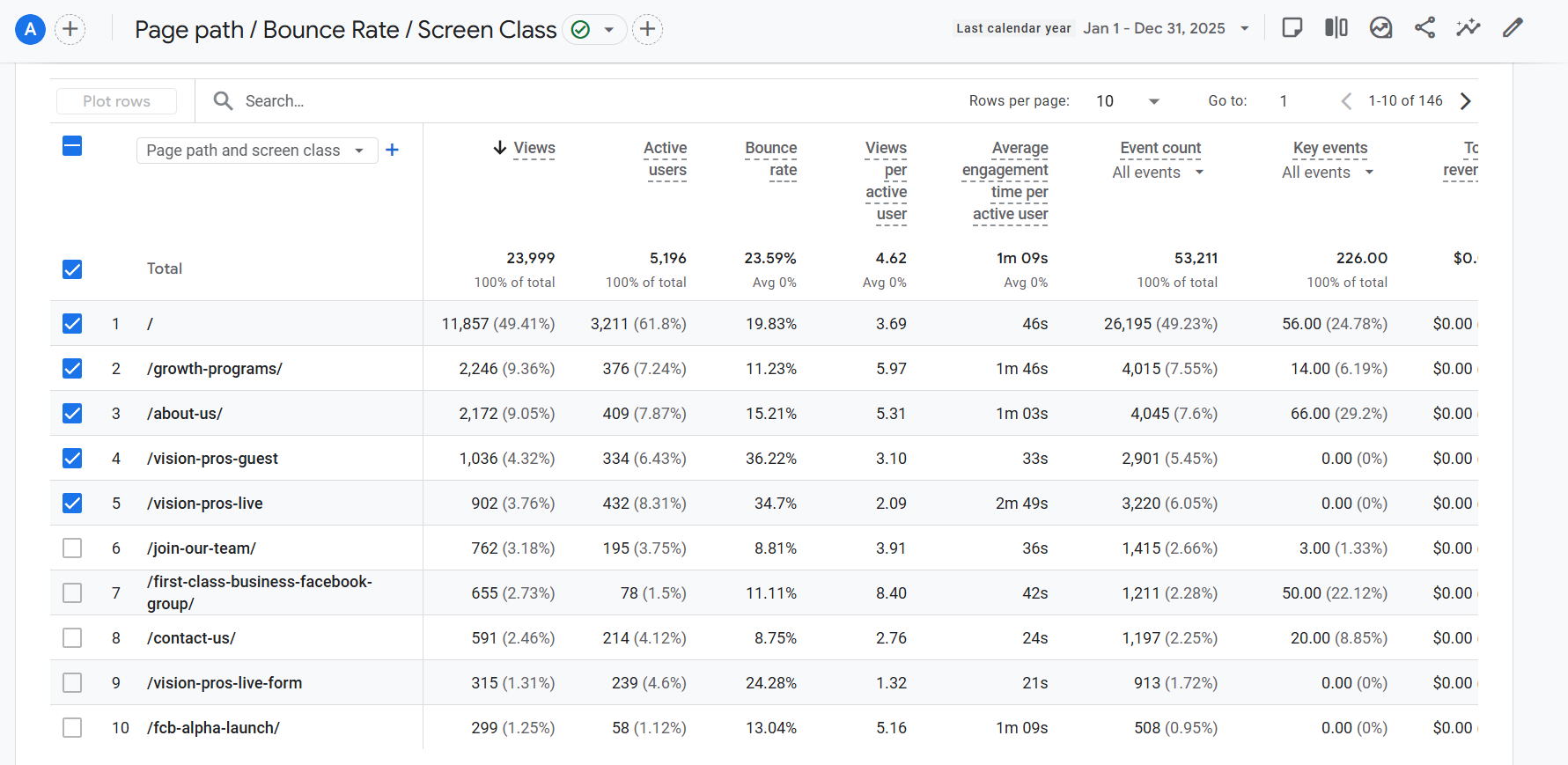
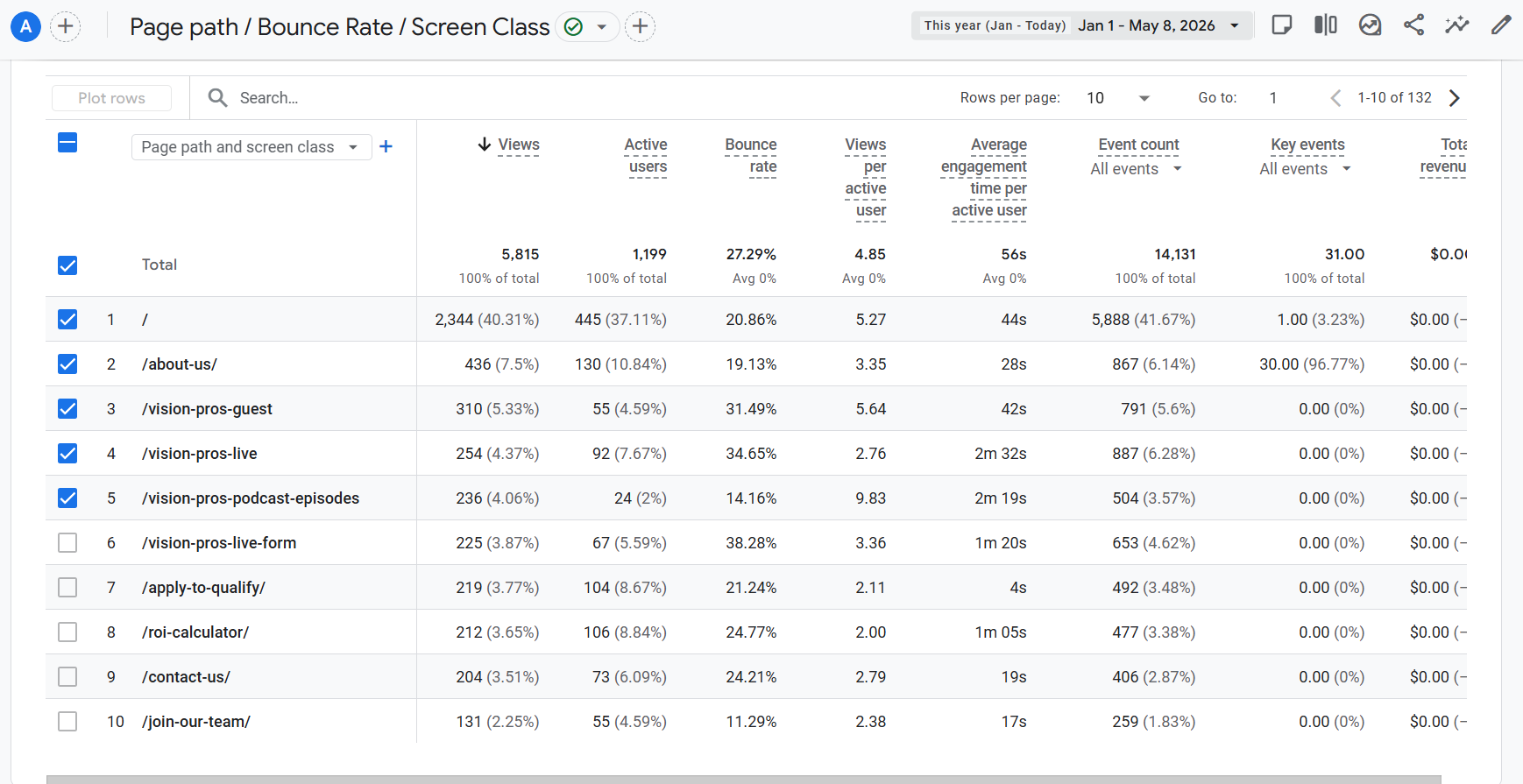
And here's where we are in 2026 so far.
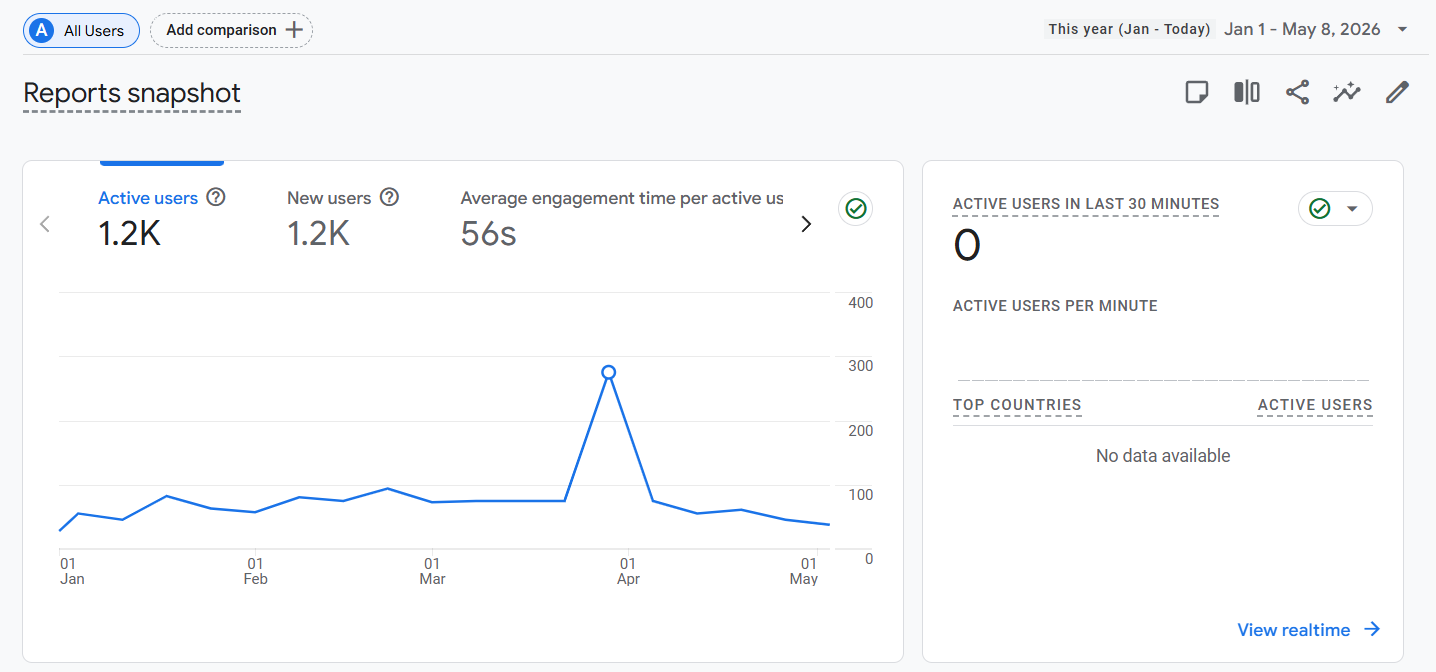
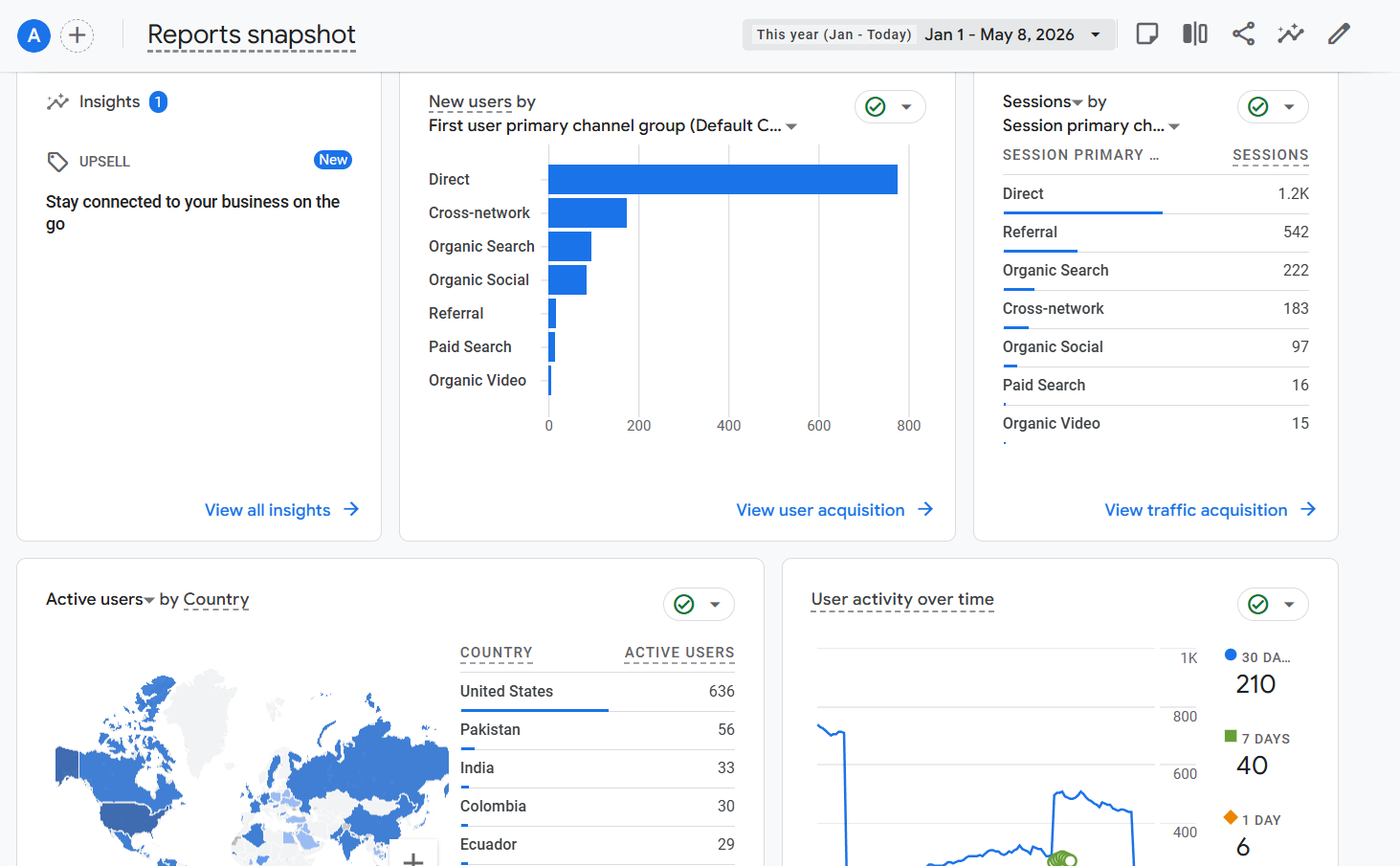
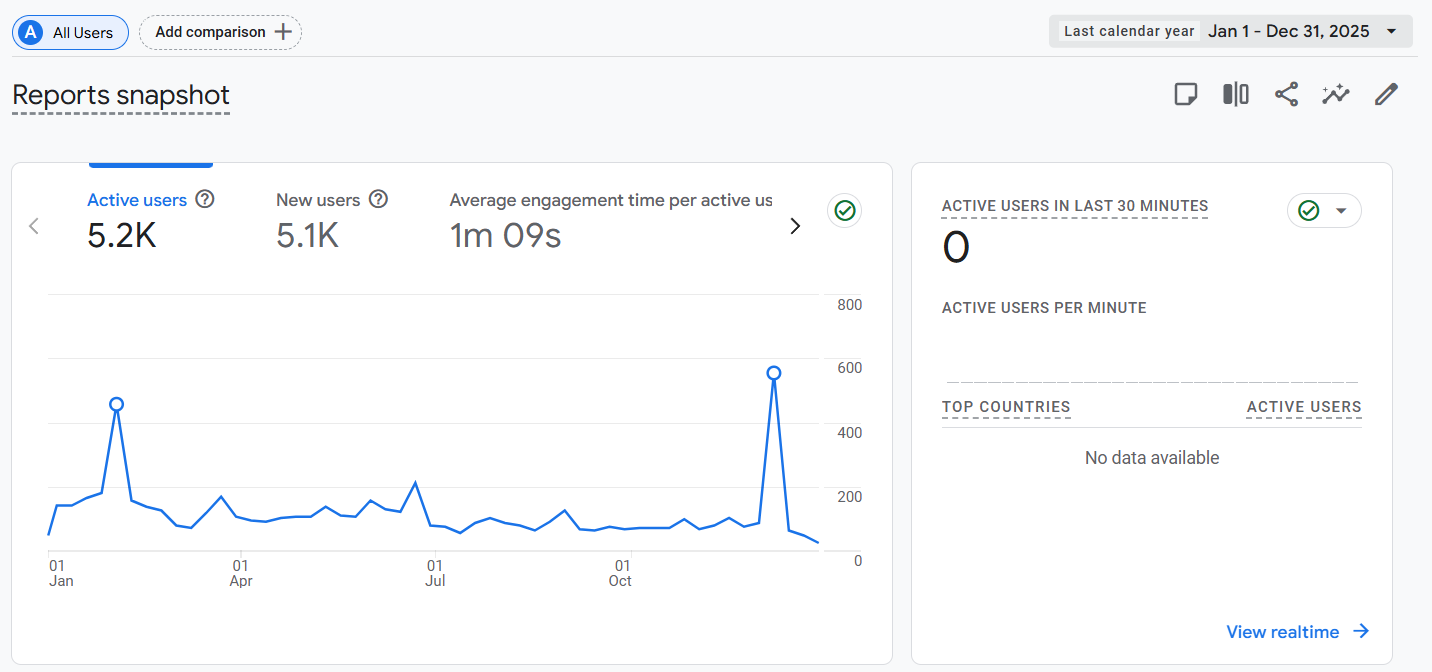
Our traffic has actually gone down a little bit this year, and that makes sense. We moved from four podcast hosts of Vision Pros Live to one, from twenty team members to six, and we focused our efforts on the quality and expansion of the podcast. The April spike was the blog launch announcement on LinkedIn.
Our focus won't be on gaming this process to win a perceived victory in six months. It will be on what's best for those we serve. Between the blog and our continued expansion of YouTube ads, I'd anticipate growth far beyond 110% — but I'll attribute most of that growth to come from our YouTube channel ads, not the blog. The Vision Pros Live YouTube channel is already at 10,000 subscribers. First Class Business is at 400 with no ads. Once we launch ads for First Class Business, that grows substantially and dramatically impacts inbound website visitors.
Our blog is on a subdomain (go.firstclassbusiness.io), not the primary domain. So these stats may not directly correlate to the blog's performance. We may not see all blog traffic in this view, but we will still see how the trend moves — which should be a strong indicator.
If not, sorry. This blog stuff isn't our core area of expertise. I'd rather focus on winning and building with principle than try to be the true nerd who gets it all correct and can claim "I'm right." Winning is better than being right.
Once this is organized enough to publish, I will likely be delegating it to a team member so they can study it out and clean it up. They will then be the leader in charge of helping us take all of this to new heights. I'm just trying to provide them with a deep enough foundation to build well from.
I predict that someday I'll care about what this means — but that won't fully transpire until one of my team members can explain this well to me. From what I observe, this means our content will likely be recognized and valued by AI within two months. In other words: it should start to become visible to a rather sophisticated audience of limited size this very month. As we refine the content and improve it, citations will nearly double.
If things go well with the team, we'll likely have much stronger expertise on this within three months. So as we plan to update this, you can expect a far more educated version of Jackson — while knowing that the real value of all of this will likely transpire in 4–6 years. That's my prediction. If we get there sooner, hallelujah.
In The AI Exchange this week, I asked Claude to tell me who I should be following as a mentor or leader, based on information I then shared with Claude about my own expertise. Claude responded: "H. Jackson Calame."
That was a bull-crap response based on an obvious bias, and while I asked it to provide a list and to not brown-nose, the lesson stayed with me. It's going to be very hard to self-diagnose success in AI search if you attempt to "verify your results" manually.
I'm sure there are systems we will learn about because of this. Today is not the day.
I don't have a prediction because I don't really understand what this is saying will occur for us, or by when. This is a good time to note that while this is a phenomenal article that took me more than 40 back-and-forth deep dives with Claude AI to produce, this process is not designed to be "finished" or perfect. It's simply a look over the shoulder at how we do things.
Your results will certainly be different from mine. I guess we can look forward to more clicks. But the underlying caveat worth paying attention to is this: if a brand is being cited by AI, it's likely because it's put a ton of due diligence into creating relevance. Which means their arrival at AI isn't necessarily boosting their success in clicks as much as it's an indicator that those brands are deemed valuable by users due to everything else they've already done.
My prediction is that this will be true. But we need to juxtaposition it with the reality of the study mentioned earlier in this article. If the content sucks, it'll actually drive people away from us. Creating tremendous value cannot be forgotten in a desire to be heard.
I have no idea how many articles I will produce per month. I will only produce content that is relevant and value-based, on my bandwidth. The pace sounds accurate, considering the amount of systems and processes we are flushing out publicly this year.
One important caveat: we do not currently have the subscription active, we don't currently have a publishing rhythm, and we aren't currently proactively promoting articles on social media. Once those distribution strategies are implemented, the inbound volume will inevitably increase. I'd predict we are rocking and rolling with all of those activities within six months.
Twelve months is when the compound effect the research promises actually starts to be measurable. The numbers below come from operators who held the line.
My prediction is that our brand results will look nothing like CoSchedule, because there are far more variables to account for than most business leaders want to oversimplify.
In typical full transparency: if we only saw an organic traffic lift of 300%, we wouldn't even come close to 75,000 leads — let alone 75 leads. Ha. And we're fully aware of that, and prepared for a steady and true journey. Slow is smooth. Smooth is fast.
If we happen to scale to that size of lead depth by then, it will certainly be because of our infrastructure improvements, advertising, and our commitment to excellence to our clients and community growth. I predict the blog will likely have a highly positive impact on our progress towards scale, but it will always be a supplemental addition, not the primary driver of our growth. Happy day if it proves me wrong.
This KPI feels redundant, but I predict there's not a chance. Claude AI is pipedreaming.
I'd predict that if we define a lead as a visitor who opted in, then we'd be very fortunate to have 20,000 within 12 months.
Once again, Claude — prove me wrong and you'll make my day.
My observation is that Claude misunderstood this part of the assignment. I find it funny and insightful for users who may get frustrated with AI when trying to build solutions like this one.
My friends — AI is like a child prodigy, super-intern, or junior advisor. It is severely limited. So be patient, persistent, and demand excellence and truth. But know that it cannot get things right without extremely intentional guidance.
Claude was supposed to produce a forecast of what we could accomplish by considering case studies. In this case, it accidentally presented the case studies as the forecast. I could correct it, but I want to watch the Spurs game. Go Wemby.
My prediction is that we will crush through a 700% ROI — because we've never had a conversion via organic traffic. When you're starting at zero, it's better to put a solid number on the wager.
Here are the five concrete bets I'm placing, each one attributable to the blog or SEO efforts fairly directly:
-
12+The AI
Marketplace -
4Power
Launch -
4The Leadership
Academy -
2The Practice
Labs -
2Oportunidades
Latinas
My prediction is that someday I might understand this one. My observation is that, yes, we will have earned-media distribution grow. Our podcast authority has greatly bolstered our opportunities for this, and the recent achievement of 10,000 subscribers on YouTube is definitely opening new doors.
Part of the opportunity and challenge will be pursuing the applications and interviews necessary to appear.
LeBron James and JJ Redick were super smart to take the PR narrative into their own hands. While they both have to participate in media appearances due to NBA rules, by launching their own podcast they have an environment where they're not being asked leading questions, they're not as restricted in their responses, and they can better connect with their audiences.
Our YouTube channel and podcast distribution methods, in addition to our blog posts, now give us far more power over our messaging and presence. And yes, that will absolutely lead to AI citations as we produce content that is meaningful to those who seek our guidance and expertise.
Eight KPIs. Twelve sources. Two horizons. Public on the day this article goes live, public again at month six, public again at month twelve. The forecast is the floor; my read is the wager; the comparison is the point.
Before we walk through how to build, here are the concrete returns the data shows for thought leaders who actually maintain a real publishing practice. Not vanity metrics. Business outcomes that show up in the pipeline, in the inbox, and in the loyalty of the audience.
Five returns. One discipline. The architecture you are about to learn is what makes those returns reachable instead of theoretical.
Here is the part that no productivity hack will fix.
In 1990, a Stanford psychology graduate student named Elizabeth Newton ran an experiment that has since become foundational to communication research. She divided participants into two groups: tappers and listeners. The tappers chose a well-known song and tapped out its rhythm on a table. The listeners had to guess the song.
Before the listeners gave their guesses, Newton asked the tappers to predict how often the song would be correctly identified.
The tappers heard the full melody in their heads while they tapped. They could not unhear it. They genuinely could not simulate the experience of someone who only heard the irregular tapping with no melody underneath. The gap between what they thought they were communicating and what was actually being received was real, measurable, and almost invisible to them.
This is the curse of knowledge, and it is the structural reason most experts who try to write about their craft produce content that nobody reads. Once you know something deeply, your brain forms efficient pathways that process the information automatically. Concepts that once required effortful explanation become background. You assume your readers share that background. You skip what feels obvious because, to you, it is obvious. You publish a piece that, in your head, sounds like the full melody. Your reader hears irregular tapping.
The cure is not "write more clearly." The cure is structural. You need a system that forces you to specify the audience, the foundation, the principle, the proof, and the practical implication for someone who does not yet know what you know. Without that system, the curse will defeat your willpower every time, no matter how hard you try.
We are going to walk through the architecture of the First Class Business library now. Not to showcase it. To make the principles transferable.
If you build your own version of this for your own discipline, the specific labels will be different. The structure will not be.
Most blogs have categories. We do not have categories. We have eight foundations — load-bearing pillars of the discipline we teach.
A category is a topic. A foundation is a load-bearing pillar of the discipline you are teaching. When a reader looks at our foundation list, they are not looking at a content menu. They are looking at the architecture of a complete business. If we publish heavily in Marketing and never in Fulfillment, the gap is visible.
Foundations create accountability. The library cannot lie about what we know and do not know.
For your own field, the question to ask is: what are the four to ten load-bearing pillars that, taken together, define mastery? Those are your foundations. Specific enough to be diagnostic, broad enough to encompass real range, and locked once chosen. Reordering them later breaks the system you are about to build on top of them.
Foundations are necessary but not sufficient. They are still abstractions. To make a foundation actionable, it has to be broken into the specific principles that operationalize it.
We did this for Culture — the foundation that breaks the most often when teams scale. Five sub-values, one for every reader's specific cultural problem.
Every Culture-tagged article in the library carries one of those five sub-values, displayed in italic cyan in the article card and exposed as a filter when a reader is browsing Culture specifically. The sub-values turn a foundation into a diagnostic.
For your own work, ask: which of your foundations carries the most internal complexity? That is the foundation that needs sub-values. Most disciplines have one or two. They will be the difference between a reader who finds what they need in three clicks and a reader who leaves because everything sounded relevant and nothing felt specific.
Foundations describe the discipline. Sub-values describe the principles. Topics describe the practice — the specific things people actually do, build, struggle with, and want to learn.
When a topic has no published article yet, it still appears in the cloud, marked as dormant. Clicking a dormant chip does not return an empty page. It opens a request modal where the reader can vote, propose a guest contribution, or submit their own perspective.
Dormant chips are demand-capture infrastructure. The reader who would have bounced from an empty page becomes a logged signal about what the market most wants from us next. Your gaps become as informative as your published work.
The Power Marketing Funnel is the proprietary axis we built on top of the standard architecture. Invisible as a filter. Surfaces as quiet metadata at the foot of every article card.
Every article carries two funnel attributes — one for the reader's state, one for the article's intent.
We did not surface this as a filter for v1 of the library. It lives as quiet metadata at the foot of each card. Two separate layers, two separate readers, one piece of content.
For your own field, the question is: what is the journey your reader is on, and what is the role each of your articles plays in that journey? Asking it this way is rare. The result of skipping it is usually a library where every article tries to do everything, and where the conversion path is left to chance instead of designed deliberately.
Most blogs lose readers at empty pages. We capture them. The implementation is technically modest. The strategic implication is large.
The result is an inversion of the normal blog economics. Most blogs treat their gaps as embarrassments. We treat ours as demand signal. Most blogs ask "what should we write next" by guessing. We ask the reader directly, at the exact moment they were looking for the thing we have not yet written.
For your own version, the principle is this: wherever your library is incomplete, build a primitive that converts incompleteness into engagement. A reader who finds nothing and leaves is a loss. A reader who finds nothing, votes, and leaves an email is the beginning of a relationship.
The smallest detail. Possibly the most important one for long-term durability.
At the top of the HTML for our library, in a comment block invisible to readers, lives the canonical reference for every architectural decision we have made.
Systems decay when their authors leave them. A future contributor — another writer, another developer, the future version of you — should not have to rebuild understanding from scratch every time they touch the system.
If you build your own version, write your architecture down inside your architecture. Put it where the next person will find it without being told to look for it. That is how editorial systems survive personnel changes, software migrations, and the founder's own forgetting.
You can copy a structure. You cannot copy a discipline. The discipline is what determines whether the structure compounds or rots.
Three commitments separate the practices that work from the practices that fail.
If you are reading this and recognizing yourself, here is the order of operations.
- 01 Define your foundations first. Not your topics. Not your titles. The four to ten load-bearing pillars that, taken together, describe mastery in your discipline. Lock them. Order them. Write them down in a place where they will not move.
- 02 Identify the foundation that carries the most internal complexity. Define its sub-values. Five is a good number. Three is acceptable. More than seven means you have not yet finished thinking.
- 03 Map the practice. What are the specific things people actually do in your field? Group them into buckets. Constrain the count. Resist the urge to create a topic for every passing interest. The discipline of refusal is what gives the system its credibility.
- 04 Decide what your equivalent of the Power Marketing Funnel is. Every discipline has one. In coaching, it might be the stages of a client engagement. In medicine, it might be the diagnostic-to-treatment arc. In teaching, it might be the learning progression from foundational to advanced. Map it. Tag every piece with where it sits.
- 05 Build the empty-state surface. Decide what happens when a reader looks for something you have not yet written. Make sure it is not a 404 page. Make sure it captures the intent that brought them there.
- 06 Write the architecture down inside the architecture. Make it survive you. The next contributor, whether that is another writer, another developer, or a future version of you, should not have to reverse-engineer the system from looking at outputs.
- 07 Then publish. Not constantly. Reliably. Not generically. Originally. Not to sell. To serve.
The library compounds from there.
We did not build this system because we wanted a fancy blog. We built it because we have spent decades watching brilliant people lose their voice in the market for lack of a structure that would carry their thinking forward. We have watched founders abandon their craft because they could not see how their hard-won lessons would ever escape their own heads. We have watched consultants and coaches and operators publish a flurry of articles, get nothing back from them, and conclude that thought leadership was a scam. It was not. The structure was missing.
If you take one thing from this article, take this. Your knowledge is not the bottleneck. Your willingness to publish is not the bottleneck. The architecture is one of the most consistently overlooked bottlenecks, and it is the part nobody told you you had to build.
If you have a decade worth publishing, where it lives matters. Not on a stage. Not in a private client document. On the public internet. Structured. Searchable. Citable. Durable.
Build the library. Then the library will build the rest.
This post is a special case — it took more than 50 iterations to best serve the reader. See Claude's first attempt to compare what AI can do alone vs. with a professional guide.