The $100 Decision That Changes Everything for Podcast Guests
Most podcast episodes plateau after launch. We built a model where they don't have to. Here's why more Vision Pros Live guests are choosing to invest $100 in their episode, and what the early data looks like.
First Class Business | March 2026
The Podcasting Problem Nobody Talks About
Alex Sanfilippo, the founder of PodMatch and host of Podcasting Made Simple, has been sounding the alarm for years: there's a 94% failure rate among podcast hosts and guests. Most people quit before they see meaningful results.
The math behind that number is painful. Thousands of episodes get recorded every week. The majority get published, shared once or twice on social media, and then disappear into the algorithmic void. The host moves on to the next episode. The guest moves on to the next appearance.
"Publish and pray. Share and disappear. That's not a strategy. That's a lottery ticket dressed up as a content plan."
The content that both parties invested real time and energy into creating reaches a handful of people and flatlines.
Great conversations happen on podcasts every single day. But without a distribution strategy, even the best episode is a tree falling in an empty forest.
Alex and his team at PodMatch have done extraordinary work solving the matchmaking side of this equation, connecting the right hosts with the right guests through tools like PodMatch, Podcasting Made Simple, and the PodValue Initiative, which has paid over $1,000,000 back to podcast hosts. That infrastructure matters enormously.
What we're building at Vision Pros Live addresses the other half of the equation: what happens after the episode is published.
What We Decided to Do About It
At Vision Pros Live, we made a decision: we would offer every guest the option to invest $100 into their episode's visibility after it goes live.
Here's how the $100 breaks down:
The episode itself becomes the ad. Not a trailer. Not a clip. The full conversation. Every paid view counts toward the episode's organic view total, which means the algorithm treats the paid and organic views as one number. This compounds reach in a way that traditional ad campaigns don't.
Our VA team manages the campaign setup, targeting, optimization, and reporting. But there's something bigger happening here. Your $50 directly funds professionals in underserved markets who are building executive-level skills through real campaigns with real budgets. In communities where books, courses, and formal training are luxuries most can't access, your episode is treated as something sacred. Real knowledge, delivered by a real person, to people who wouldn't otherwise receive it.
The targeting uses a global geo-arbitrage model: we run ads in the most cost-effective English-speaking markets worldwide. This means $50 in ad spend goes dramatically further than it would in the US, UK, or Australia alone.
The guest's choice is simple: invest $100 and give your episode a real distribution push, or publish organically and see what happens. There's no pressure. Some guests choose to invest. Some don't. Both are welcome.
What the Early Data Looks Like
We launched this model in March 2026. The results in the first three weeks have been striking.
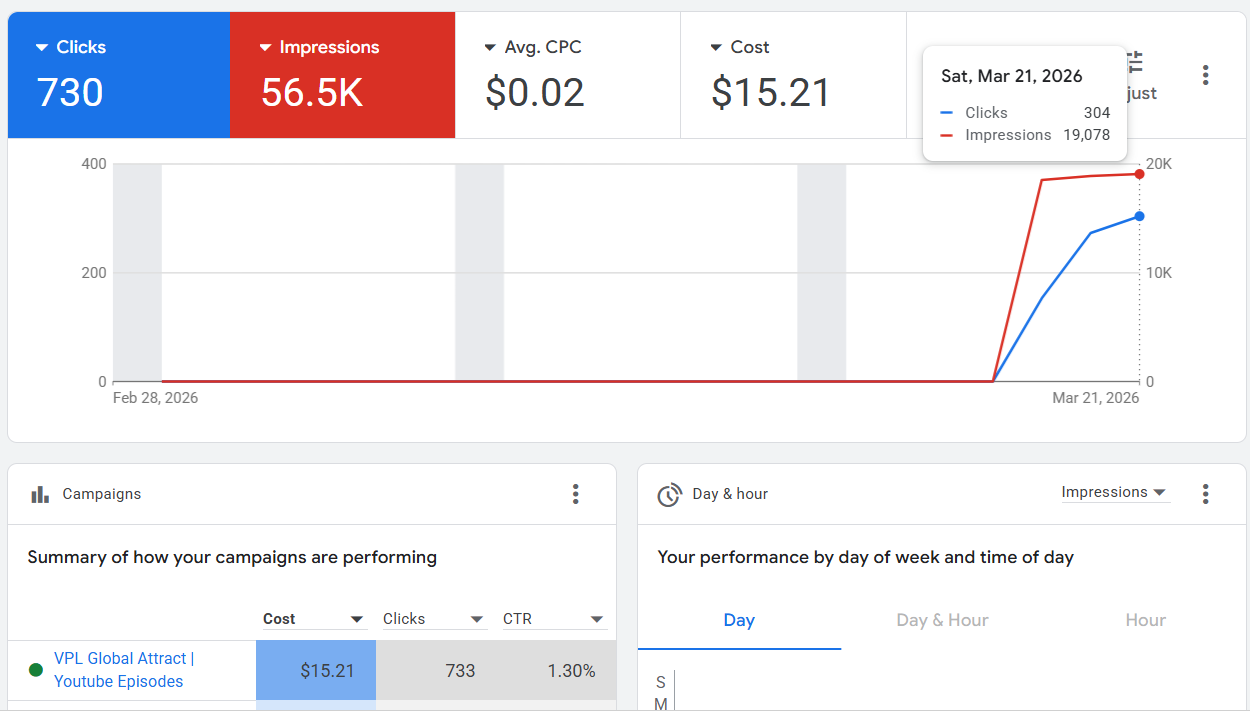
Let those numbers sit for a moment.
741 new subscribers in 5 days. On $15.21 in total ad spend. That's roughly $0.02 per subscriber gained. In a normal week, the channel was averaging about 160 views. In the last four days of this window, the channel received 2,839 views.
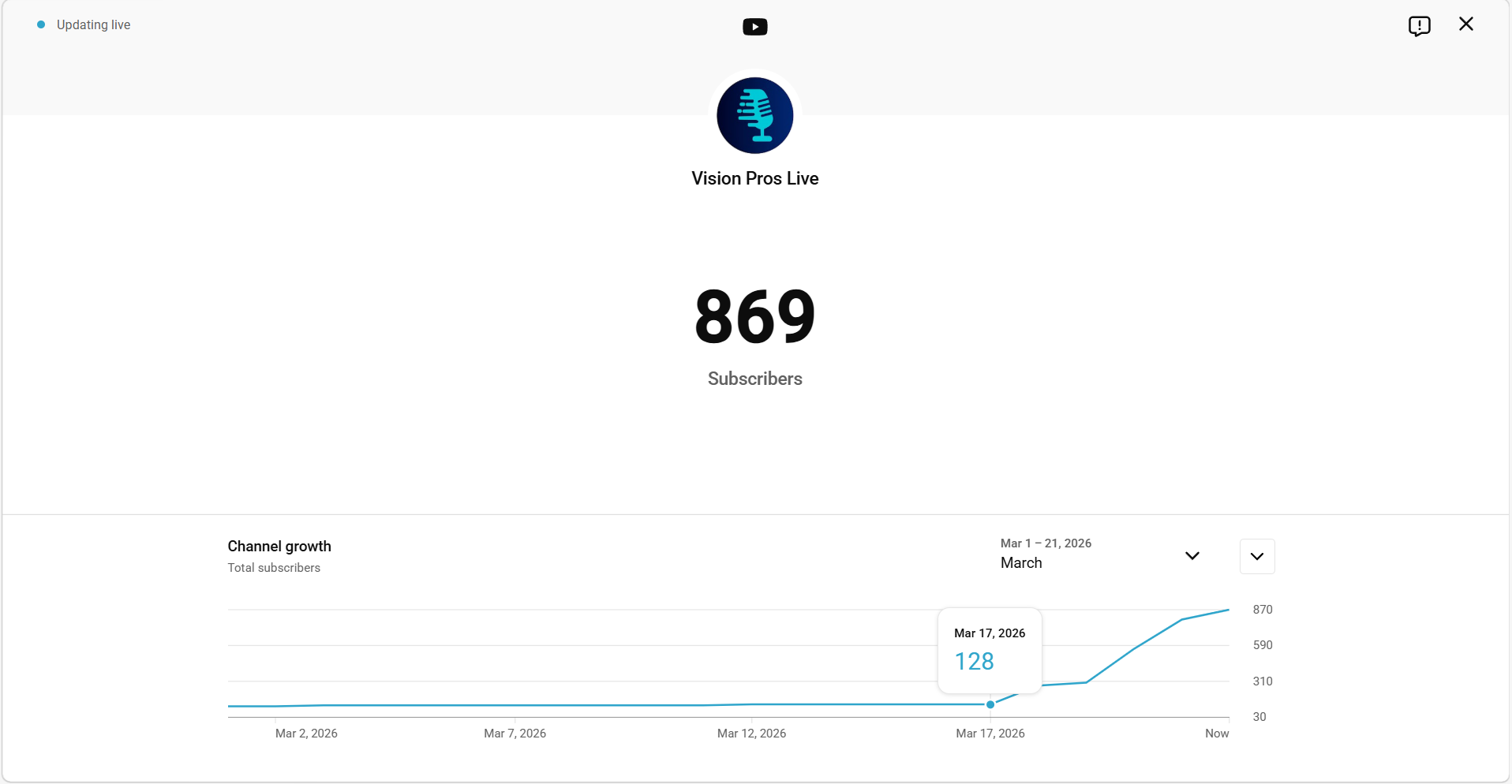
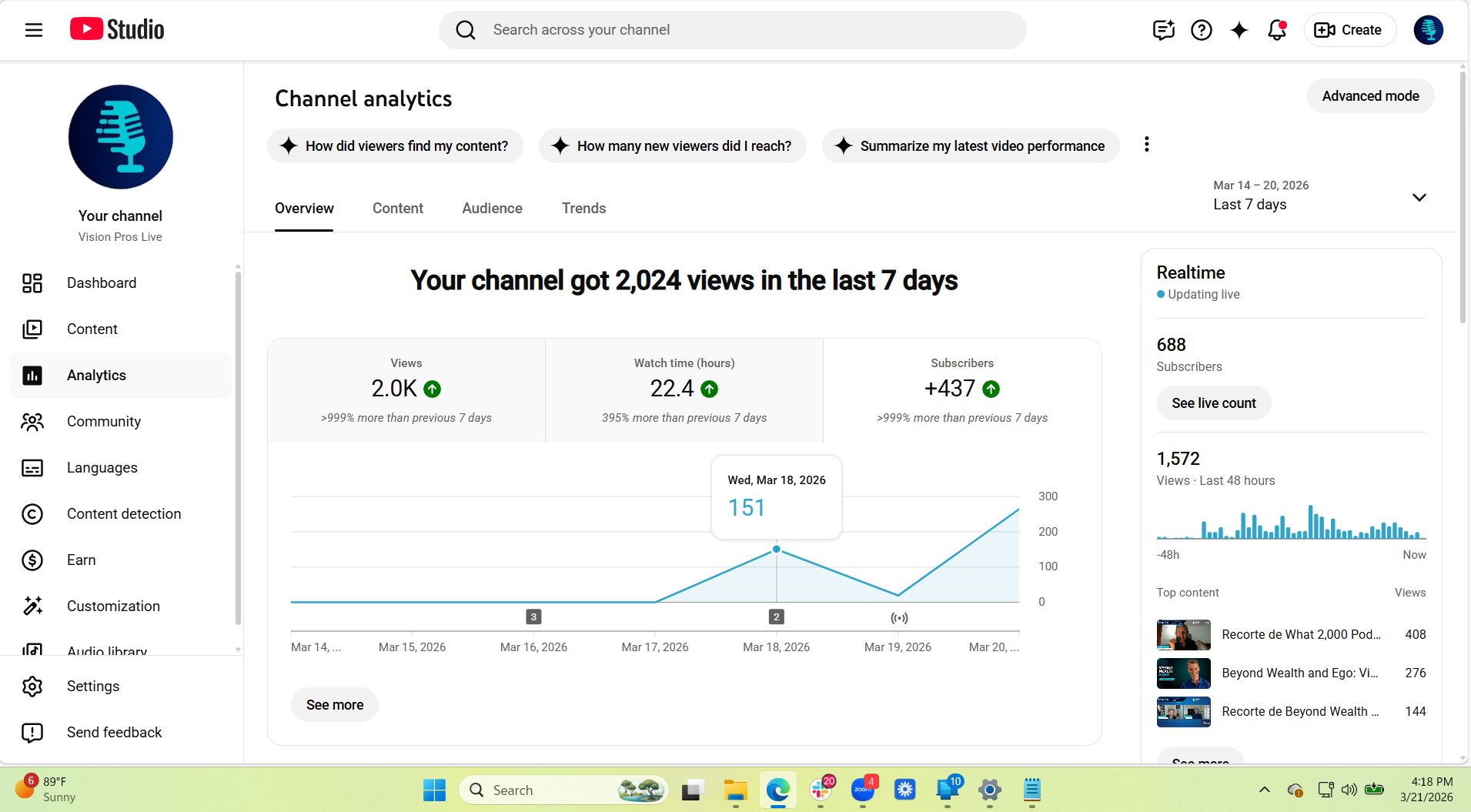
This is early data. The sample size is small and we're transparent about that. But the trajectory is worth paying attention to, especially when compared to the alternative: publishing an episode and hoping the algorithm picks it up.
Why This Math Matters for Guests
When you appear on a podcast, you're investing something more valuable than money. You're investing your time, your expertise, and your reputation. The episode represents you to an audience that may be encountering you for the first time.
If that episode reaches 12 people organically, was the investment of your time worth it?
How do you think your prospects feel when they search your name and see that your interview only reached 6 people?
If that same episode, backed by $100 in strategic distribution, reaches thousands of targeted viewers, the calculus and reception change entirely. That earns respect and attention.
Visibility for your episode in front of a global, English-speaking audience that the algorithm would not have served it to organically.
Organic algorithm lift. Because paid views count toward organic totals on YouTube, the paid push signals to the algorithm that the content is worth recommending. This creates a compounding effect that outlasts the ad spend itself.
A professional team managing the campaign. You don't touch Google Ads. You don't optimize targeting. You don't pull reports. Our team handles all of it.
Proof of concept for your own brand. If the numbers work at $100, imagine what happens when you scale the investment to $500 or $1,000 on your own content. This is a test drive for what a real visibility strategy looks like.
Why Most Podcasts and Agencies Won't Do This
The traditional podcast model doesn't include post-publication advertising as a standard offering. Most podcasts publish and move on. The episode lives in the feed. If someone finds it, great. If not, there's always next week.
Most marketing agencies won't recommend a $100 YouTube ad campaign either. The margins don't work for them. An agency managing a $50 ad spend isn't generating enough revenue to justify the labor. Their business model requires larger budgets to be sustainable.
That's not a criticism of agencies. It's a structural reality. And it means that for most podcast guests, there's simply no one offering this service at this price point.
We're able to do it because the model serves multiple goals simultaneously: the guest gets visibility, the episode gets reach, the channel grows, and our team develops real skills with real campaigns. The $100 funds the entire loop.
The Bigger Picture
Alex Sanfilippo built PodMatch on a simple principle: find the real problem and offer the fastest solution. He asked 100 podcasters at a conference what they were struggling with. The answer was clear. He built the tool.
We're approaching the post-publication problem with the same energy. The question we asked:
The answer was equally clear: because most episodes have no distribution strategy and no budget behind them.
The $100 model is our answer. It's not the only answer. But for guests who want their episode to reach more than a handful of people, and for podcasters who want their channel to grow in a measurable way, it's a model worth considering.
Your episode represents your expertise,
your story, and your reputation.
It deserves more than a publish date
and a prayer.
The data speaks for itself.
The decision is yours.
Data referenced in this article: Vision Pros Live YouTube channel analytics, March 2026. Google Ads campaign data, "VPL Global Attract | YouTube Episodes" campaign. Alex Sanfilippo / PodMatch statistics from Podcasting Made Simple and PodMatch.com. All subscriber and view counts are from YouTube Studio as of March 22, 2026.
Interested in appearing on Vision Pros Live?
We're always looking for founders, operators, and professionals with a story worth sharing.
Learn More